
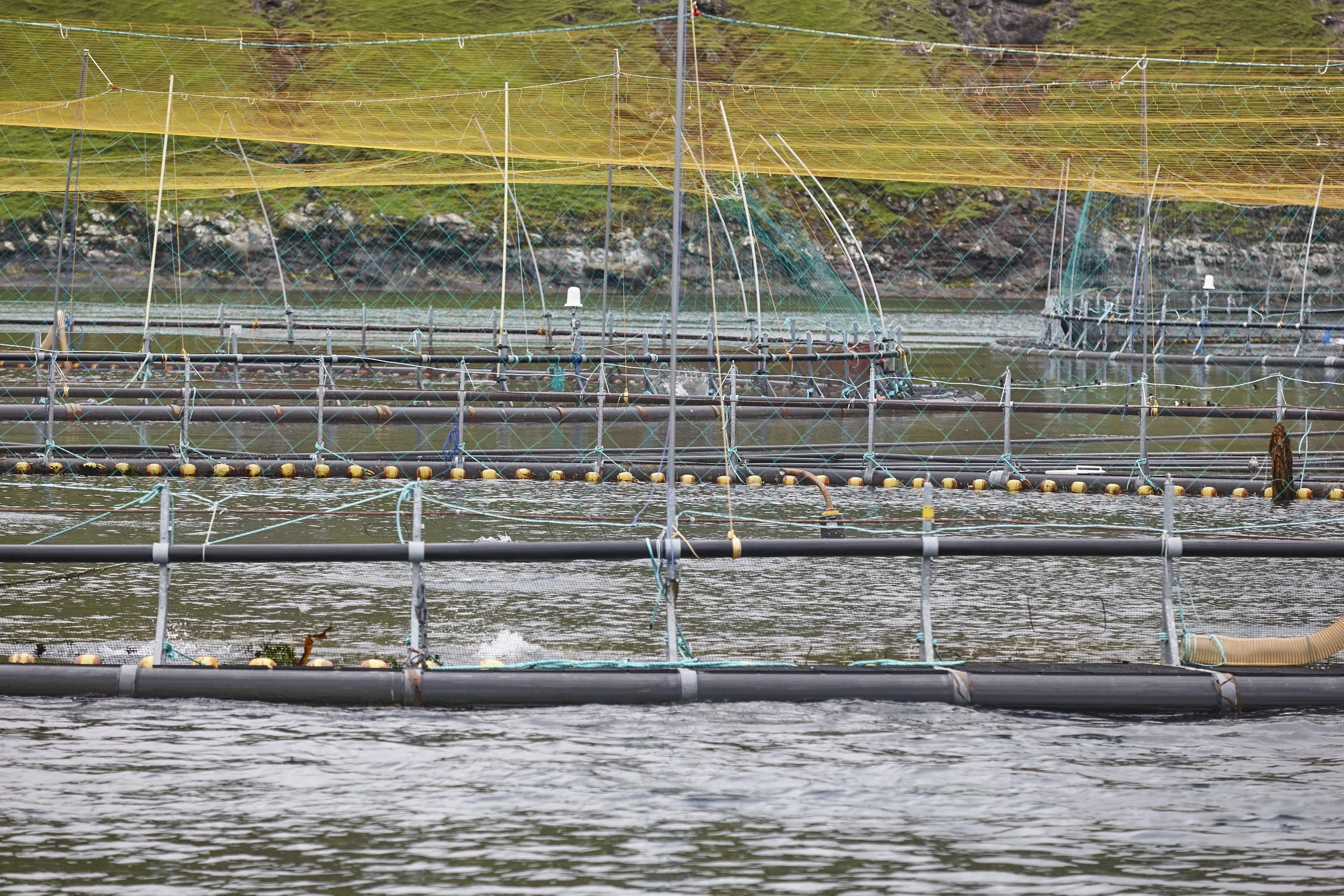
Norway has a long seafaring tradition, with high fish consumption and export value. A global leader in wild catch and, more recently, aquaculture, its seafood exports reached a record NOK 181.5 billion (€16.6bn) in 2025, according to the Norwegian Seafood Council. At 2.8 million tonnes for the year, that is equivalent to 38 million meals a day.
With fishing quota reductions now squeezing the industry and farming methods increasing, companies are continuously examining opportunities where waste and side streams can be converted into marketable products. Recovering resources and energy within these value chains is both a necessity and a challenge.
On the catch side, heads, bones, skin and organs, once discarded at sea, are increasingly rendered into protein meal and oil. On the farming side, sludge from aquaculture systems, historically a disposal problem, could be dried into fertiliser, soil amendment, biogas feedstock and feed ingredients.
Mineral-rich sludge from fish farming, made up of uneaten feed, faeces, microbial matter and other fine particles is a wet by-product, so it needs dewatering and drying before it can be transported, stored or processed further — a step where industrial heat pumps can replace fossil-based heat.
The HubSirk framework for circularity: Reduce, re-use, re-cycle
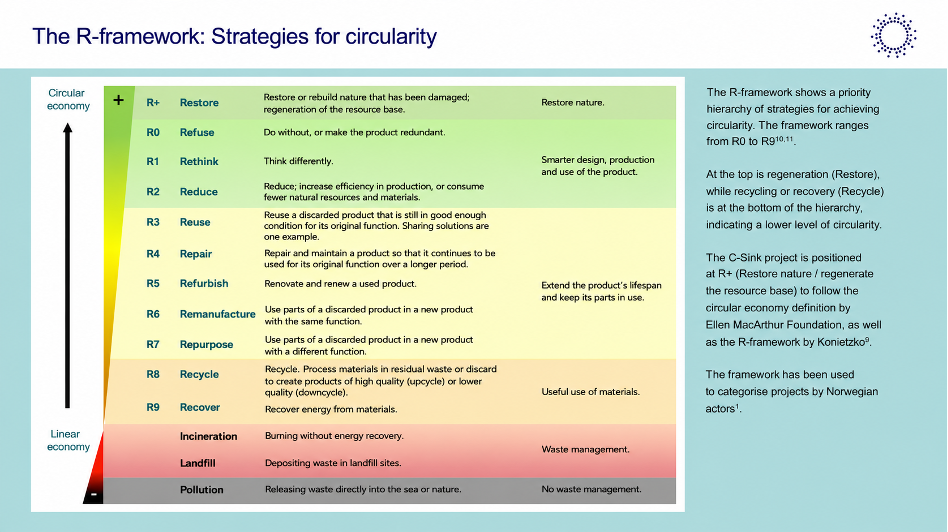
Table courtesy of Hub for Ocean.
Earlier this year Norway’s Hub for Ocean cluster launched a new type of seminar for the blue industries. Hub Sirk is an initiative from Hub for Ocean and Brand Valley and is designed to be a meeting place for the marine industry to make better use of all resources. Enerin is a member of Hub for Ocean.
Norway’s HubSirk report, From Value Chain to Value Circle, maps how fish offcuts, sludge, silage, hatchery wastewater and thermal waste can feed these new value chains, using an R-Framework presented by Lene Borgen Waage of Vestland County Municipality. The event, called Hubsirk, was held for the first time in Førde.
The report ranks circular strategies from R0 to R9, nature restoration at the top and energy-from-combustion near the bottom, plus an R+ tier — reflecting the Ellen MacArthur Foundation's emphasis on regenerating natural systems — as the outcome of doing the rest well, not a starting point. Companies that move up through recycling, repurposing and remanufacturing reduce their draw on virgin resources, which also means recovering and re-using waste heat before defaulting to combustion.
A concrete example: Heat recovery in wild-catch processing
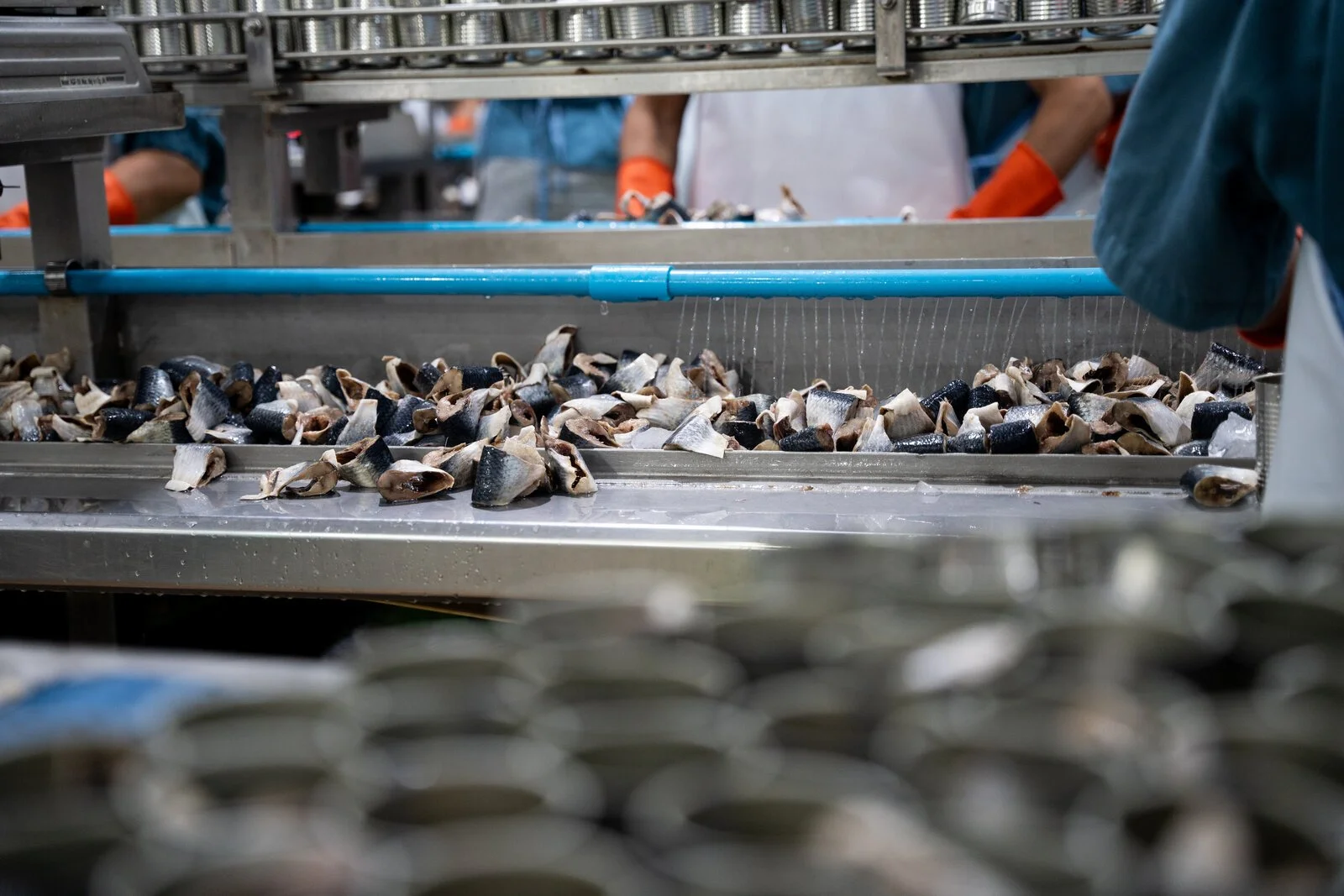
After the prime cuts are processed, the fish remains are turned into fish meal and oil in pursuit of zero-waste.
Fish processing factories increasingly turn leftovers from prime filets into animal feed and fish oil, a process requiring energy-intensive cooking, evaporation and drying.
Since 2025, the HoegTemp high-temperature heat pump has operated alongside other heat pumps and boilers at Pelagia's facility in Måløy, part of the company's push toward CO2-neutrality. There, Enerin's 400-kilowatt Stirling heat pump re-captures waste heat from the fish meal and oil processes, and upgrades it for heating, boiling and drying.
Demand is intermittent: the plant ramps up from cold to full capacity whenever a shipload of fish arrives, then cools once processed. Steam demand, pressure and waste heat temperatures vary throughout the batch/cycle, and the HoegTemp is flexibly following those variations.
The heat pump takes in waste heat between 20°C and 90°C and delivers steam at 2–5 barg, corresponding to 140–165°C, via an external water circuit with integrated heat exchangers — working much like a conventional boiler alongside the site's other units. Connected to seawater, HoegTemp could theoretically supply steam even before waste heat becomes available, extending uptime.
A research pilot at the same site is testing whether combining HoegTemp with superheated steam drying can cut energy demand while preserving the protein quality that determines fishmeal value.
Through rethinking the process, waste heat is recovered and reused while the whole fish is used by Pelagia for sustainable and profitable operations, reducing both the energy need and waste from fish processing.
Future options: Reducing energy and recovering value from fish farming
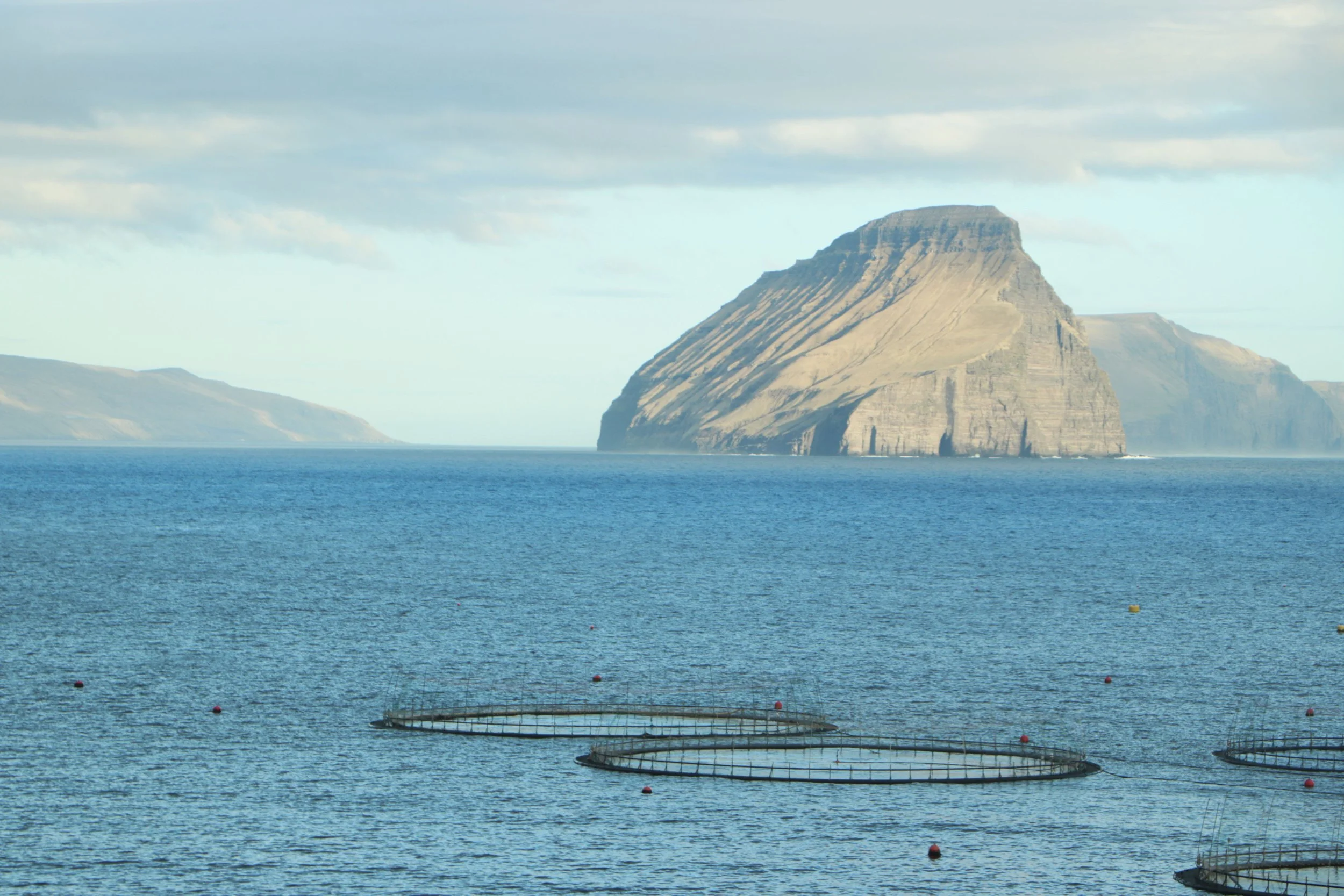
After juvenile fish, or smolt, are raised in hatcheries they are transferred to sea pens.
Raising fish in freshwater tank hatcheries requires continuous water circulation which is energy intensive. In re-circulating aquaculture systems (RAS), juvenile salmon need a stable volume and temperature of water to thrive at the smolt stage before being transferred to sea pens.
RAS, once limited to early hatchery stages of fish growth, is increasingly extended into post-smolt production. Smolt production and the potential for solid waste collection in Norway, by Andre Meriac, quoting Klemet Steen from Lerøy AS in the Nofima Report 25, July 2019, states that up to 70% of post-smolts stocked in sea pens in Norway are now sourced from RAS. There is also a trend to grow bigger smolt to decrease their time in the sea cages where they can be exposed to marine parasites, like sea lice, which can increase their mortality rate, says The Fish Site.
Because an increasing number of salmon are raised for longer periods of time in RAS, more waste, or sludge, is generated from the fish and uneaten food, including higher cumulative energy demands through recirculating water that needs heating and cooling. The subsequent increase in energy consumption from this runs approximately three times higher than for traditional sea pens or cages. (Philis et al. (2019), Comparing life cycle assessment (LCA) of salmonid aquaculture production systems: status and perspectives; Sustainability.)
The Meriac report states that the growing use of RAS for raising bigger smolt results in the need for more waste water-treatment systems, which gives farms a ready-made waste stream than can be exploited. Where the sludge can't be discharged directly into waterways, due to eutrophication problems where excessive algae blooms block light and oxygen for marine life, on-site sludge-treatment and de-watering systems reduces the volumes for storage and treatment. The de-watered sludge contains high value nutrients and energy, which can be utilised in production of fertiliser or biogas.
There are more opportunities for biogas plants to work with fish producers and industrial heat pump manufacturers, particularly as RAS farming expands. HubSirk has identified pathways through which dried sludge becomes raw material for fertiliser, biogas via anaerobic digestion, and feed ingredients for cultivating marine bait worms.
Following the logic of nature restoration further, it would mean moving beyond fossil-fuelled drying for de-watering sludge, and instead re-use thermal energy, or waste heat, via heat pumps and green electricity for zero-emission processing. Recirculating water via heat pumps also present opportunities for value chain actors.
The opportunity ahead
The opportunity extends beyond managing waste better: it lies in unlocking new value streams from resources already present in seafood production. The challenge is connecting the heat, technology, biological streams and local actors needed to make circular loops commercially viable. This would position Norway's seafood sector as a model for a restorative industry.