
Machine learning AI improves Stirling HTHP COP prediction
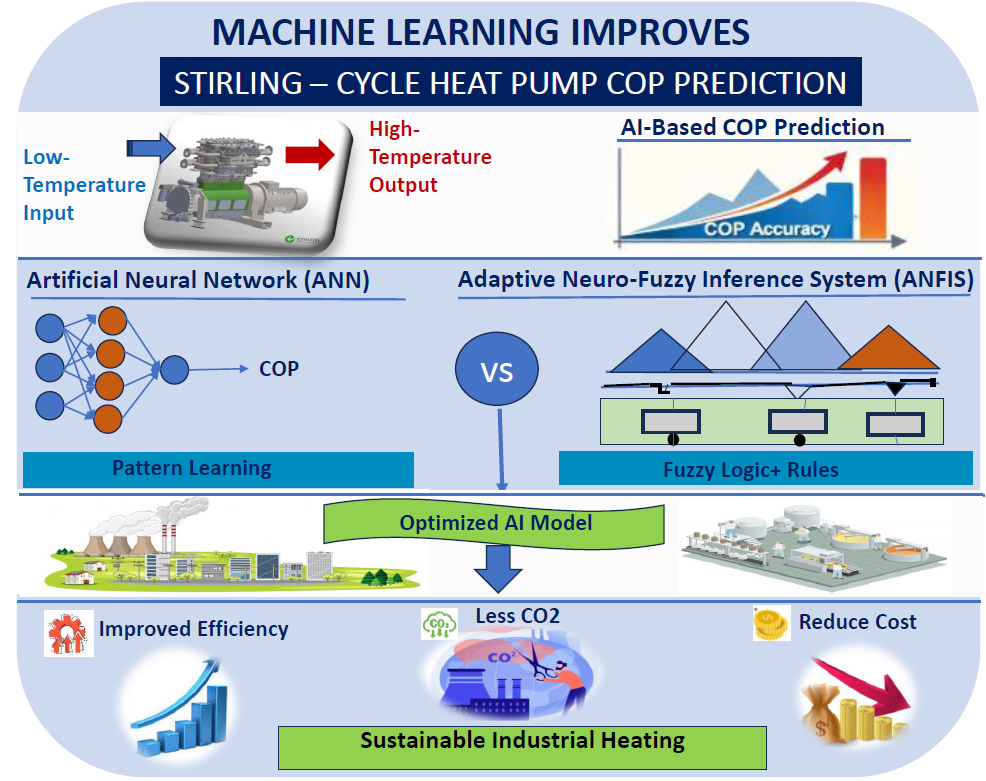
Copyright: Iman Golpour, UNED.
A new study shows how artificial intelligence (AI) can accurately predict the performance of a Stirling-cycle industrial heat pump targeting greater efficiency, reducing costs, energy waste, and emissions — all of which support the electrification of high-temperature industrial processes.
By using predictive models, operators could run heat pumps more efficiently by aligning operation with periods of low-cost or low-carbon electricity while maintaining output with less energy. This not only improves system performance but also reduces strain on electricity grids.
Accurate COP prediction rests on best AI selection process
A key factor in heat pump performance is the Coefficient of Performance (COP), which measures efficiency. Machine learning models facilitate accurate COP estimation, provided the right model is chosen and its parameters are carefully tuned.
The study comparing the performance of AI models — ANN and ANFIS
The scientific paper Intelligence-Based Prediction of Coefficient of Performance for a Novel High-Temperature Industrial Heat Pump: Comparative Performance of ANN and ANFIS Models was authored by Iman Golpour (lead author), from UNED, and colleagues, including Enerin CEO Arne Høeg. The paper was published in Energy and Buildings (Elsevier) in April 2026.
The work was conducted as part of the European SUSHEAT project, co-ordinated by the Energy Engineering Department at Spain’s National University of Distance Education (UNED). Enerin is a project partner.
The researchers compared two machine learning approaches:
Artificial Neural Networks (ANNs).
Adaptive Neuro-Fuzzy Inference Systems (ANFIS).
Both models were used to predict COP across a range of operating conditions.
Stable performance makes Stirling cycle HTHP ideal for AI
Stirling-cycle heat pumps are particularly well-suited for integration with AI models because they respond to industrial demand, operate efficiently at high temperatures, and perform consistently rather than chaotically.
“This makes them ideal for 'charge when optimal, deliver when needed' strategies,” says Iman Golpour, lead author of the published study.
New research tackles key gap in using AI for Stirling-cycles
While machine learning has been applied to other heat pump technologies, this study addresses a key gap by focusing on Stirling-cycle high-temperature heat pump (HTHP) systems.
Importantly, the models were trained using real data from Enerin’s Stirling HoegTemp industrial heat pump installed at the IVAR biogas plant. The system operated under demanding conditions, with source temperatures of 21–22°C and sink temperatures ranging from 139–199°C.
High predictive accuracy across both models, led by ANN
In simple terms, ANN models learn patterns directly from data by assigning weights to input variables, while ANFIS combines data-driven learning with rule-based logic, making it effective for modelling complex, non-linear relationships.
“Both models showed strong predictive capability based on the selected models and input data, although the ANN model delivered slightly higher overall accuracy,” Golpour said.
The findings show how AI can support the design and operation of industrial heat pumps, particularly the Stirling-cycle, improving energy efficiency and reducing electricity use.
AI-powered heat pumps could speed the move beyond fossil fuels
By enabling reliable performance prediction under real-world conditions, the research supports wider adoption of HTHPs as an alternative to fossil-fuel-based industrial heating.
This contributes to industrial decarbonisation by lowering greenhouse gas emissions and supporting the transition towards the electrification of heat.
Improved efficiency also reduces operating costs, helping make sustainable technologies more economically attractive and accelerating their uptake in energy-intensive sectors.
In the next blog Iman Golpour explores the practical implications of these findings in more detail.