
Stirling HTHP ideal for AI-led pre-start performance prediction and savings
Following our previous blog on the newly published paper Intelligence-Based Prediction of Coefficient of Performance for a Novel High-Temperature Industrial Heat Pump, which demonstrated how artificial intelligence can accurately forecast the performance of Stirling-cycle systems, we now take the story further.
In this second installment, we speak directly with the lead author Iman Golpour, a post-graduate engineer at the National University of Distance Education (UNED), Spain, to unravel the thinking behind the research published in Energy and Buildings (Elsevier), April 2026.
As industries move towards wider deployment of high-temperature heat pumps, understanding which AI models perform best, and why, offers clear industrial value. Optimizing operation based on process demand and energy pricing can reduce costs, ease grid pressure, lower environmental impact, and support maintenance planning.
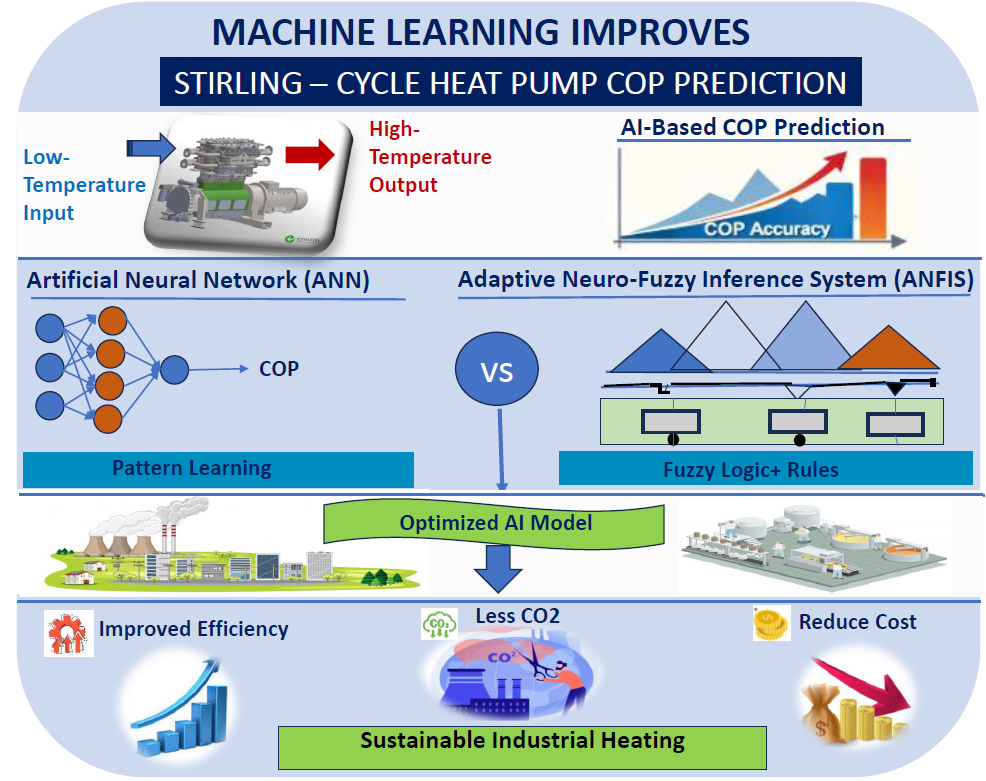
In this follow-up, Golpour explains the two AI models used in the study: Artificial Neural Networks (ANNs) and Adaptive Neuro-Fuzzy Inference Systems (ANFIS). The study shows that ANN delivers higher prediction accuracy and that Stirling-cycle industrial heat pumps are particularly well suited to AI-based modelling due to their stable and predictable behaviour.
Why was this study conducted?
Industrial heat pumps are capital-intensive, complex systems expected to operate reliably at very high temperatures. Accurate performance prediction enables better system design, smarter operation, and avoidance of unnecessary energy consumption and operational inefficiencies.
Why is this important for high-temperature process heat?
Stirling heat pumps can operate efficiently at high temperatures while following industrial demand. This makes them well suited to strategies such as “operate when optimal, deliver when required.”
Predictive models provide operators with accurate efficiency estimates under varying conditions, enabling data-driven decisions rather than relying on assumptions.
For industrial stakeholders, this is critical, as high-temperature process heat requires stable operation, high efficiency, and intelligent timing.
By applying predictive models, operators can:
Align operation with low-cost or low-carbon electricity.
Avoid inefficient operating conditions.
Deliver the same thermal output with lower power consumption.
This results in reduced costs, lower emissions, and decreased strain on the grid.
What does this mean in practice?
The heat pump operates more when electricity is cheaper or renewable.
Inefficient operating points are avoided.
Performance is known before system start-up.
This helps to:
Reduce electricity consumption and CO₂ emissions.
Support grid stability.
Improve operational planning and maintenance.
Why are Stirling-cycle heat pumps particularly suitable?
Stirling heat pumps can deliver high-temperature heat electrically and operate beyond the limits of most conventional systems. In addition:
They avoid phase-change complexities.
They exhibit smooth and predictable behaviour.
Their performance is highly suitable for data-driven prediction and optimization.
“But it’s not just about prediction. It’s about confidence, scalability, and smart operation, allowing the integration of flexible, low-carbon heat where fossil systems are still dominant,” Golpour said.
This makes them especially compatible with AI models, which perform best with stable and consistent systems.
By contrast, conventional heat pumps:
Struggle at very high temperatures.
Experience rapid efficiency losses.
Are more difficult to control precisely.
What were the major findings?
The study demonstrated that AI models can predict heat pump efficiency with very high accuracy before operation.
Both ANN and ANFIS performed well.
ANN showed near-perfect agreement with measured data.
ANN outperformed ANFIS for this application.
Give us a comparative scenario that we can understand.
Imagine two students learning to predict machine performance:
Student A (ANN) learns patterns from large amounts of data and becomes highly accurate.
Student B (ANFIS) uses predefined rules but is less consistent.
Both perform well, but Student A consistently delivers more precise predictions. This reflects the study results, where ANN captured system behaviour with exceptional accuracy.
Why was the prediction so accurate?
The system was tested under real industrial conditions.
Input parameters strongly influence performance.
ANN effectively captures complex, non-linear relationships.
In essence, the model does not simply estimate performance; it learns how the system behaves.
What further work is needed?
Validation with larger datasets.
Inclusion of dynamic operating conditions.
Integration with real-time control systems.
Comparison with other high-temperature heat pump technologies.
The next step is moving from prediction to control and, ultimately, automation.
How close is this to real-world application?
The technology is not far from implementation. Prediction models are already well validated, and integration into real-time systems is expected within the next few years.
The research was conducted as part of the European SUSHEAT project, coordinated by the Energy Engineering Department at Spain’s National University of Distance Education (UNED). Enerin is a project partner.
Copyright: Iman Golpour, UNED.