
The courage to replace fossil heat — Enerin will be in Stavanger for ONS 2026
OFFSHORE NORTHERN SEAS FORUM
Founded after the 1973 oil embargo, Norway's Offshore Northern Seas (ONS) forum returns this August with energy security back at the top of the agenda, with a growing conviction that the answer is electrification, not more oil.
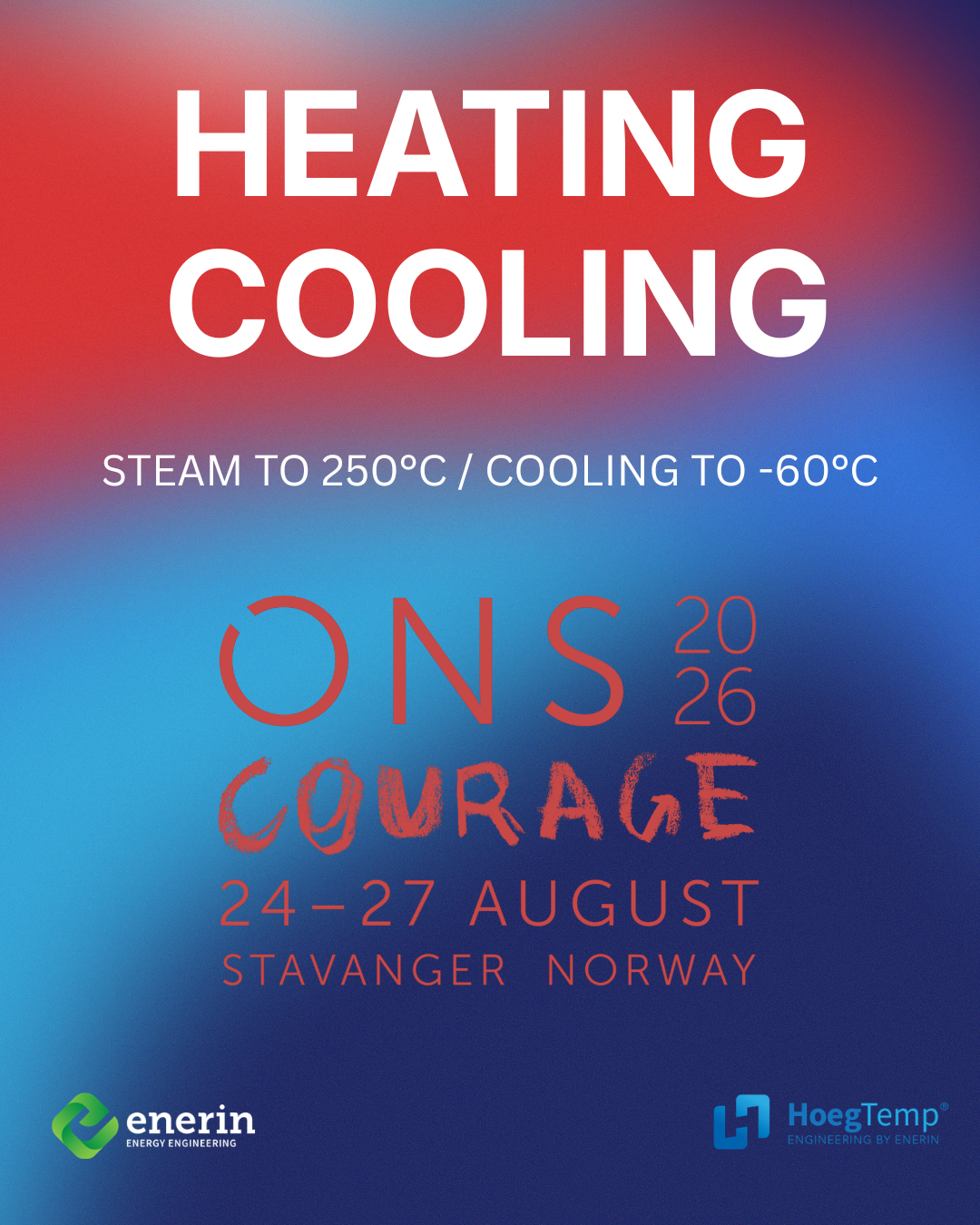
Enerin's reverse Stirling cycle HoegTemp industrial heat pumps replace gas-fired systems for process heat up to 250°C.
On the cold side, the heat pump can also reach temperatures down to -60°C, opening the door for a range of applications including high-quality fish freezing and CO₂ liquefaction.
WHERE TO FIND US
ONS 2026 – Stavanger Forum: Hall 8, Stand 8300 (Research Council of Norway).
24–27 August 2026, Stavanger, Norway.
Our team: Enerin Founder and Head of Concept Design, Trond-Atle Asphjell, and CCO Ralph Groen.
Few events bring together the worlds of geopolitics, energy, industry, and climate at the scale of the ONS forum, held every two years in Stavanger, Norway. Enerin will be there this August at the invitation of the Research Council of Norway. The timing of the event could not be more telling.
ONS was first held in 1974, created not long after Norway's first offshore oil production at Ekofisk (June 1971) and the 1973 OPEC oil embargo — a geopolitical shock that forced the world to confront its dependence on a single region's fossil fuel production.
It is not lost on anyone attending ONS 2026 that the same question has returned: disruption across the Strait of Hormuz and the Red Sea affected around one quarter of total global seaborne oil trade in the first quarter of this year. The forum born from one energy crisis opens half a century later against the backdrop of another. And Norway, a strong NATO ally, remains one of Europe's most reliable energy neighbours, supplying oil, gas and power to the continent precisely when security of supply matters most.
What has changed since the first ONS is that the world now has an alternative. Rising wind and solar generation and accelerating electrification have cushioned the blow in ways not available in 1973. Energy security and decarbonisation are not competing goals; they are the same goal. Industrial heat pumps sit at exactly that intersection, able to electrify the fossil fuel stronghold in industry by converting renewable electricity into high-grade heat and cold with a better energy efficiency.
Courage as a call to act
This year's ONS theme — Courage — is a call to act. And while Europe needs to stay competitive, it should not soften its stance on the Emissions Trading System as industrial sectors lobby Brussels to lower the price of carbon emissions. Instead, politicians and financial institutions should show courage to tackle structural changes that are needed to accelerate electrification.
Make capital available for climate finance, invest in the electricity grid; restructure electricity markets so that renewable-generated power is no longer priced at the marginal cost of gas; reduce, or cap, the carbon tax on renewable-generated electricity; redirect carbon tax revenues into direct, accessible financing incentives for industrial first movers, clean tech SMEs, start-ups and scale-ups. And design attractive financial support schemes that are easier to navigate, with less drain on time and human resources.
Europe's most promising technologies cannot perish between proof-of-concept and commercial scale. Europe cannot afford to lead the world in clean energy innovation only to watch those technologies reach maturity elsewhere. The central challenge is no longer whether to reach net zero — it is whether political leaders will hold their course.
Climate ambition is easiest to declare and hardest to sustain when geopolitical instability, economic turbulence, electoral pressures and competing priorities crowd the agenda. What the clean energy transition needs now is consistency: stable policy, capital commitments (with the ETS as a revenue stream: The EU Heat Auction), and the institutional courage to back early movers through to commercial scale, both on the industrial and the innovative SME scale. The companies building tomorrow's industrial energy systems cannot do it alone. It is in that gap — between commitment and delivery, between prototype and market — that Enerin's technology lies.
Solving industrial heating and cooling with HoegTemp
Renewable electricity is transforming power generation. HoegTemp goes further. Using green electricity paired with available thermal sources such as waste heat, air or water, the heat pump upgrades and recycles energy into both process heat and cooling from a single machine, eliminating the need for separate boiler and cooling infrastructure.
The proof is already running near Stavanger at one of our pilot plants. Since November 2023, HoegTemp has been operating at the IVAR Municipal Wastewater Treatment Plant, simultaneously supplying heat and cooling in the biogas stream, on the doorstep of the town hosting ONS 2026.
Enerin's reverse Stirling cycle HoegTemp industrial heat pump can deliver high-temperature heat up to 250°C, with cooling to -60°C, which is suitable for CO2 liquefaction, for example, from a single integrated system. The heat pump can cover the steam and process heat requirements across a range of industrial applications.
Enerin founding partner and Head of Concept Design, Trond-Atle Asphjell, and CCO, Ralph Groen, look forward to showcasing the potential of this technology at ONS in Stavanger this August, and to the broader conversation on how zero-emission industrial heat can help close the gap between ambition and action.